
Montgomery County Arrest Records and Charges
Montgomery County arrest records are created on the law-enforcement side. They can involve a deputy, city officer, jail intake, incident report, crash report, booking process, or custody record. Those records do not automatically prove that a court charge was filed or that a person was convicted. The court charge record starts when the Montgomery County Prosecutor files a charging document in the trial court. That charge then appears as part of the court case, with status changes tracked through the chronological case summary and disposition fields.
Use the sheriff and police channels for law-enforcement reports, and use MyCase or the Clerk for filed court charges. The official sheriff services page explains case reports, crash reports, APRA timing, tax warrants, civil process, fingerprints, and background-check service channels. The Crawfordsville Police Department has its own records services page for crash reports, incident reports, and other report requests. When a person is in local custody, booking and jail status belong with the jail, while the formal charge list and final case outcome belong with the court.
The Montgomery County Sheriff services page is the official source for sheriff report channels and APRA timing.
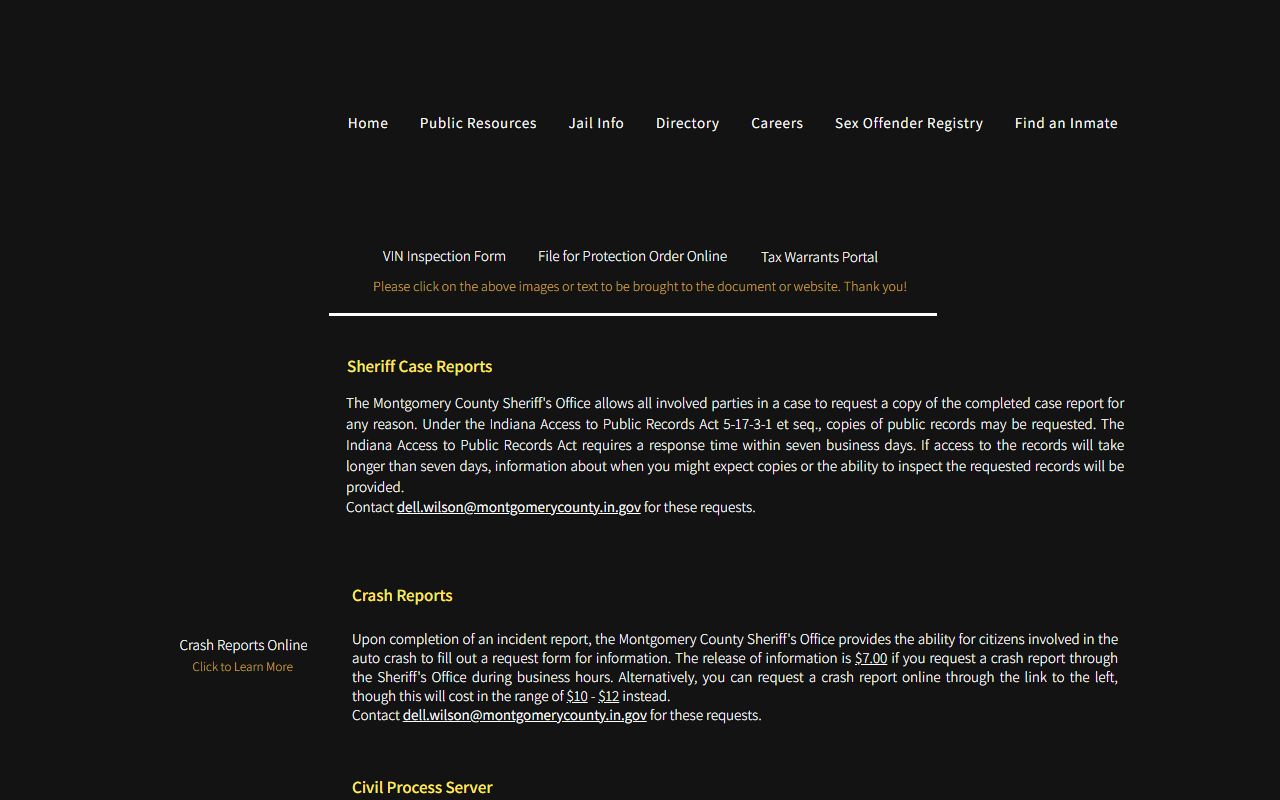
That source supports the law-enforcement side of arrest records, while filed charges are checked through the court system.
Search Montgomery County Arrest Records
The most reliable Montgomery County arrest records workflow uses more than one channel. Search Indiana MyCase for filed charges, call or visit the sheriff for jail and custody questions, and use the appropriate police records office for incident or crash reports. For court charges after arrest, MyCase can be searched by case number, citation number, cross-reference number, party name, attorney name, court, case type, status, and file-date range. Official search tips say a person-name search requires last name plus first name, middle name, or date of birth.
- Search MyCase by defendant name or known case number to find filed Montgomery County charges.
- Open the case and review each charge, level, plea, status, and disposition separately.
- Call the Clerk of the Circuit Court when official copies, missing documents, or current financial balances are needed.
- Use the sheriff or Crawfordsville Police records channel for arrest reports, incident reports, and crash reports.
- Use the jail page or sheriff phone line for current custody questions rather than assuming the court case proves custody.
Indiana MyCase is not a statewide mugshot or booking database. It is a public court-case portal for non-confidential cases in courts using Odyssey. Arrest details may be limited, absent, or held by law enforcement. Current jail status and roster limitations are covered in the Montgomery County inmate records page, while the full court case outcome belongs with criminal court records.
Arrest Record vs Court Charge
The arrest side and the charge side answer different questions. An arrest record may show that law enforcement took a person into custody or generated a report. A charge record shows what the prosecutor filed in court. The two can differ because the prosecutor may file fewer charges, different charges, no charges, or amended charges after reviewing the facts. A person may also be cited or summoned without the same jail-booking trail.
| Point | Arrest Record | Court Charge Record |
|---|---|---|
| Main Source | Sheriff, jail, or police agency. | Prosecutor filing and court case. |
| Core Fact | Law-enforcement contact, report, or custody event. | Formal accusation filed in court. |
| Search Channel | Sheriff records, Crawfordsville Police records, jail phone, or report request. | MyCase, Clerk, Circuit Court, Superior Court I, or Superior Court II. |
| Outcome | May not show final disposition. | Can show plea, dismissal, verdict, sentence, or other disposition. |
The Crawfordsville Police Department page identifies the city police agency and its public-record form route.
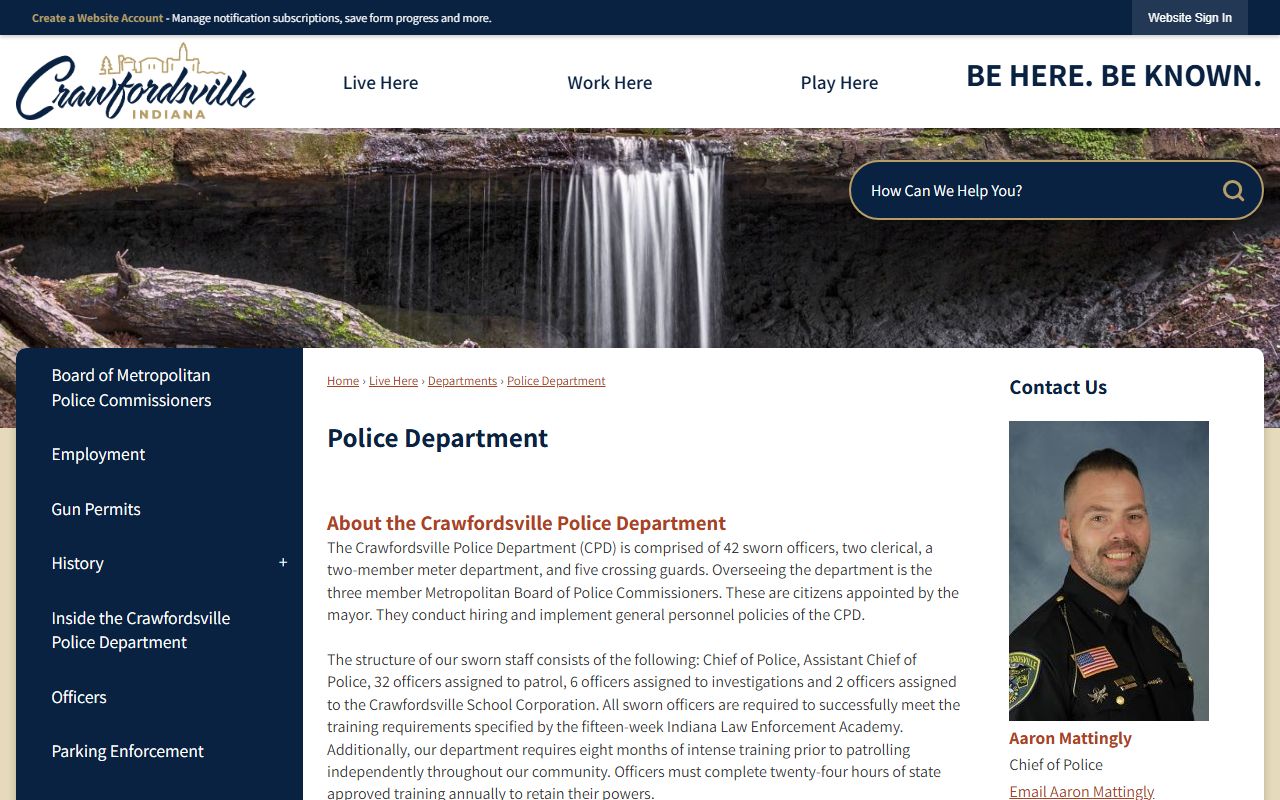
City police records can matter when the arrest or report began with Crawfordsville officers instead of the county sheriff.
Charges After Arrest Documents
Formal charges after arrest are usually tied to a charging document. Indiana practice can involve an information, complaint, indictment, probable-cause filing, or other court paper depending on the case. The research for Montgomery County confirms the prosecutor represents the State in felony, misdemeanor, traffic infraction, non-traffic infraction, and juvenile prosecutions. MyCase may display the charge list and the chronological case summary even when the underlying document image is not available online.
| Document Type | Who Uses It | What It Does |
|---|---|---|
| Complaint | Officer or prosecutor process, depending on case type. | Starts or supports a criminal or infraction case with alleged facts or charge text. |
| Information | Prosecutor. | Lists formal charges filed by the State without a grand-jury indictment. |
| Indictment | Grand jury. | Accuses a person of an offense after grand-jury action, usually in more serious cases. |
A filed charge is not proof of guilt. It is the start or continuation of a court process. Charge wording, offense level, and statute references should be read with the plea and disposition entries. The complete court file, including sentencing, is covered in the Montgomery County criminal court records page.
Montgomery County Charge Status
Charge status can change several times before a case ends. MyCase may show pending charges, amended charges, dismissed counts, plea entries, and final dispositions. One count may end in conviction while another count is dismissed. A probation violation or failure-to-appear entry can create new court activity and may connect to warrant records. Always check the latest court event and the disposition field before treating an old charge line as the current status.
| Status | What It Means |
|---|---|
| Pending | The charge has not reached final disposition in the visible court record. |
| Amended | The prosecutor or court record changed the charge wording, level, count, or related filing. |
| Reduced | The case resolved or moved forward on a lower offense than the original charge. |
| Dismissed | The charge was ended by court action and should not be read as a conviction. |
| Guilty or Convicted | The record reflects a guilty plea or finding, followed by sentence or judgment entries. |
| Expunged or Restricted | The public view may be removed or limited by Indiana law or court order. |
The Crawfordsville Police records services page describes the city route for crash reports, incident reports, and other report requests.
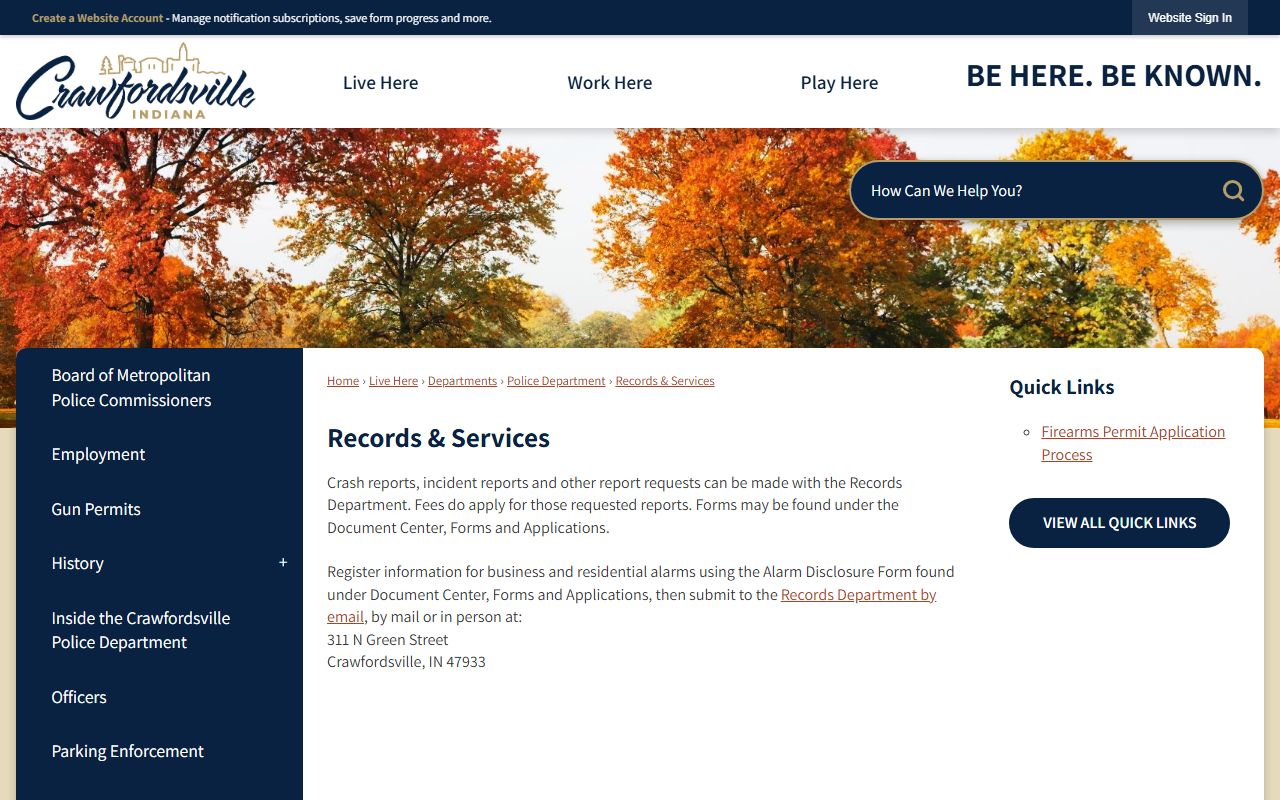
Police report access is useful background, but the charge status table must be verified against the court case.
Charges vs Convictions
Montgomery County arrest records and charge records can include allegations that never become convictions. A charge can be dismissed, amended, reduced, or resolved by plea to another count. A conviction requires a guilty plea or finding of guilt. This distinction matters for employment, licensing, housing, and personal research because an arrest or filed charge should not be described as a final criminal judgment unless the court disposition supports it.
| Point | Charge | Conviction |
|---|---|---|
| Record Stage | Filed accusation after arrest, summons, or investigation. | Final finding or plea of guilt. |
| Can Be Dismissed | Yes. | No, but it may be appealed, modified, or expunged if eligible. |
| Where to Verify | Charge list and case summary. | Disposition, judgment, sentence, and final order entries. |
| Best Practice | Read current status. | Read sentence and later compliance entries. |
Public Access for Arrest Records
Indiana's Access to Public Records Act, court access rules, and MyCase policies shape what can be viewed. IC 5-14-3 generally governs public agency records, and IC 5-14-3-4 lists records that are confidential or may be withheld. Law-enforcement investigatory material, juvenile information, sealed records, expunged matters, protected personal identifiers, and some active investigative records can be restricted.
The sheriff services page notes that APRA gives agencies seven business days to respond after a mailed or faxed request, and 24 hours for in-person requests. A response is not always the same as immediate production of every document. It may acknowledge the request, ask for clarification, cite an exception, or provide next steps. For court documents, the Clerk and MyCase are the better channels. For law-enforcement reports, use the sheriff or city police records office.
The Indiana Access to Public Records Act is the state law source for public-record access and agency response limits.
That law explains why some arrest records are requestable while others are withheld, redacted, or routed to a court record process.
Restricted Montgomery County Charge Records
Some arrest records and charges after arrest will not appear in a public search. Juvenile records are generally confidential under Indiana juvenile-record law. Protection-order cases are excluded from MyCase because protected-party identifying information is not shown online. Sealed and expunged records can disappear from public display even if the court, law enforcement, or allowed agencies retain access. Search warrants are often sealed or non-public while active or investigative.
Indiana expungement can apply to eligible arrests, charges, and convictions under IC 35-38-9. A granted petition may restrict public access, but the effect depends on the record type and order. If a Montgomery County arrest record cannot be found, possible reasons include no charges filed, a different agency holding the report, a sealed or expunged case, a juvenile matter, a name mismatch, or a record that is public only by direct request.
Access note: A Montgomery County arrest is not the same as a conviction, and a missing online result is not proof that no record exists.